
The Finest Haussmann Apartments in Paris — What Sets the Best Apart From the Rest
Every apartment built during the Haussmann renovation of Paris shares a family resemblance — the same era, the same broad architectural language, often the same cream limestone facades lining the same wide boulevards. And yet within that family, the range between an ordinary Haussmann apartment and an exceptional one is enormous, measured in details that a casual viewing rarely surfaces.
For a buyer already fluent in what Haussmann architecture generally offers, the more useful question is narrower and more precise: what actually separates the finest examples from the merely respectable ones.
The Étage Noble Is Not a Marketing Term
Haussmann buildings were designed with a clear internal hierarchy, and the second and sometimes third floor — the étage noble — was built with genuinely superior proportions: higher ceilings, taller windows, more elaborate ironwork on the balconies, and often the building’s finest original moldings and parquet. This was not a stylistic accident. It reflected who the building’s original architects expected to occupy each floor, and the construction quality followed accordingly.
An apartment on the étage noble with its original detail intact represents a different category of property than a similarly sized apartment two floors up, even within the same building — a distinction that appears nowhere in a standard listing but matters enormously to anyone evaluating true architectural merit rather than square footage alone.
What Original Detail Actually Signals
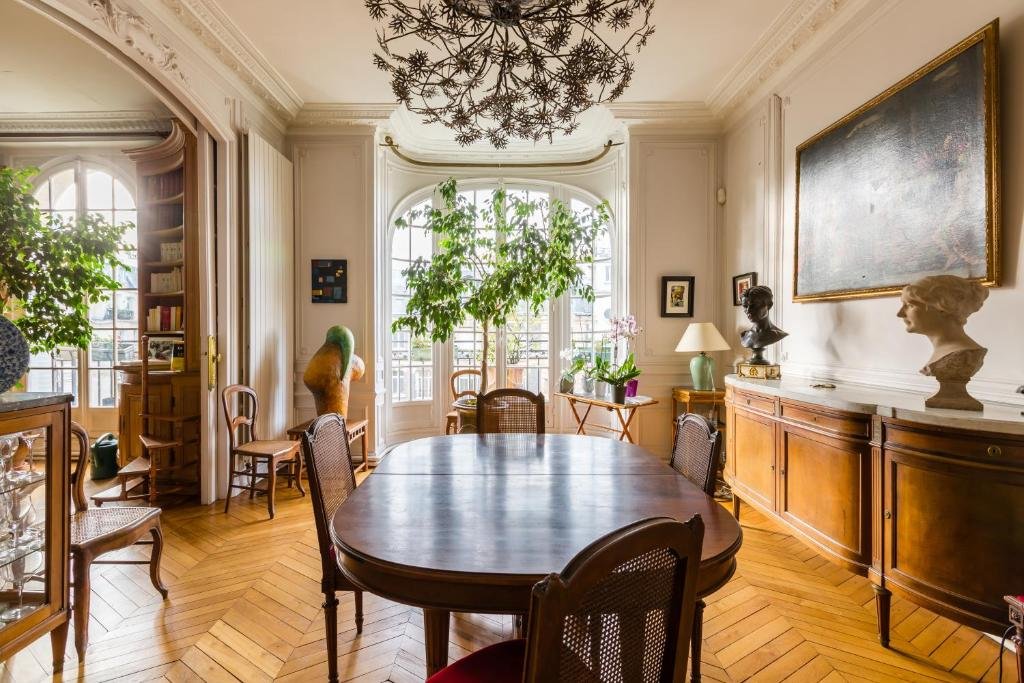
Original herringbone or Versailles parquet, marble fireplaces that have never been removed and replaced, ceiling moldings uninterrupted by later renovation work — these details signal something beyond aesthetics. They indicate a building and an apartment that has passed through successive ownership without the kind of aggressive modernization that, while sometimes necessary, permanently erases what made the space exceptional in the first place.
The most prestigious Paris addresses tend to correlate closely with buildings where this preservation instinct has been consistently maintained across generations of owners — a pattern that rewards buyers willing to look past a dated kitchen or bathroom in favor of structural and architectural integrity that cannot be recreated at any price.
Light and Orientation, Read Correctly
Haussmann apartments facing directly onto a boulevard offer the ornate facade views buyers often picture, but the finest light in these buildings frequently comes from apartments overlooking the interior courtyard — quieter, often with equally tall windows, and in the best buildings, courtyards designed with genuine architectural intention rather than treated as a service afterthought.
Southern and western exposure changes the character of a Haussmann apartment substantially across the day, and the protected luxury markets of the 6th and 7th arrondissements offer some of the clearest examples of this — buildings where courtyard apartments with the right orientation are quietly understood by connoisseurs to outperform their boulevard-facing counterparts, price notwithstanding.
The Building Itself Is the Asset
The single distinction that separates the finest Haussmann apartments from the rest is rarely visible inside the unit at all — it is the building. A well-maintained facade, a copropriété with healthy reserves and no deferred major works, an entrance hall and staircase that has been preserved rather than modernized past recognition: these collectively determine whether a given apartment will hold its exceptional character for the next owner, or slowly lose it to piecemeal renovations made without architectural coherence.
Buyers evaluating trophy-level Haussmann property benefit enormously from understanding a building’s full history and its copropriété’s financial position before falling in love with a single apartment’s interior — the interior can always be improved with the right resources; the building’s underlying integrity cannot be manufactured after the fact.
Recognizing the Genuinely Exceptional
The finest Haussmann apartments in Paris are not, in the end, defined by any single feature but by the alignment of several: étage noble proportions, uninterrupted original detail, correctly read light, and a building maintained with genuine architectural discipline over decades. Where all four align, the result is a property that a buyer’s grandchildren could inherit and find just as exceptional as the day it was purchased.
For financing considerations on acquisitions at this level, a liquidity-focused financing strategy often serves buyers better than a conventional purchase structure, preserving flexibility for the kind of considered, unhurried acquisition that trophy property deserves.
Why This Distinction Rewards Patience
Apartments meeting this full standard rarely appear on public listings, and when they do, they move quickly among buyers who already understand what they are looking at. This is precisely why the search for a genuinely exceptional Haussmann apartment favors buyers willing to wait for the right property over those working to a fixed timeline — the alignment of étage noble proportions, untouched original detail, and a soundly managed building is not something that can be manufactured on demand, no matter how motivated the buyer or how generous the budget.
In practice, the buyers who end up with the finest examples are usually the ones who spent the most time understanding what they were actually looking for before they began looking at all — a distinction that separates a satisfying acquisition from one that merely satisfies an initial impulse.
A Standard Worth Holding Out For
There is a temptation, particularly under time pressure, to accept an apartment that meets three of these four criteria and treat the fourth as a minor compromise. In most price segments, this is a reasonable trade-off. At the very top of the Haussmann market, it rarely is — the gap between an apartment that meets all four criteria and one that meets three tends to show up not immediately, but years later, in how the property is perceived, how it holds value through a full market cycle, and how effortlessly it eventually resells to the next connoisseur who recognizes precisely what they are looking at.
A Practical Test for Evaluating Any Candidate Apartment
For buyers evaluating a specific candidate against this standard, one practical test cuts through most of the ambiguity: ask to see the building’s most recent assemblée générale minutes and the copropriété’s reserve fund balance before falling further in love with the apartment itself. A building with healthy reserves and no deferred major works behind an exceptional apartment is a genuinely different proposition than the same apartment sitting inside a building quietly accumulating maintenance debt — even though nothing about that difference will be visible during a standard viewing.
This single document, more than any photograph or in-person impression, tends to separate apartments that will remain exceptional for the next owner from apartments whose current beauty is, in effect, borrowed against future costs someone will eventually have to pay.
If you are searching for a Haussmann apartment that meets this standard, Contact SHOKO.
Recommended Reads
Interior Design and Architecture — How Paris’s Best Apartments Are Transformed — 1empress.com
Why Ultra-High-Net-Worth Buyers Use a Representative, Not a Search, to Acquire Property in Paris — 1empress.com
How German Buyers Are Approaching the Paris Property Market in 2026 — gtamarket.ca
How Swiss Buyers Compare Paris Real Estate to Geneva and Zurich — gtamarket.ca