
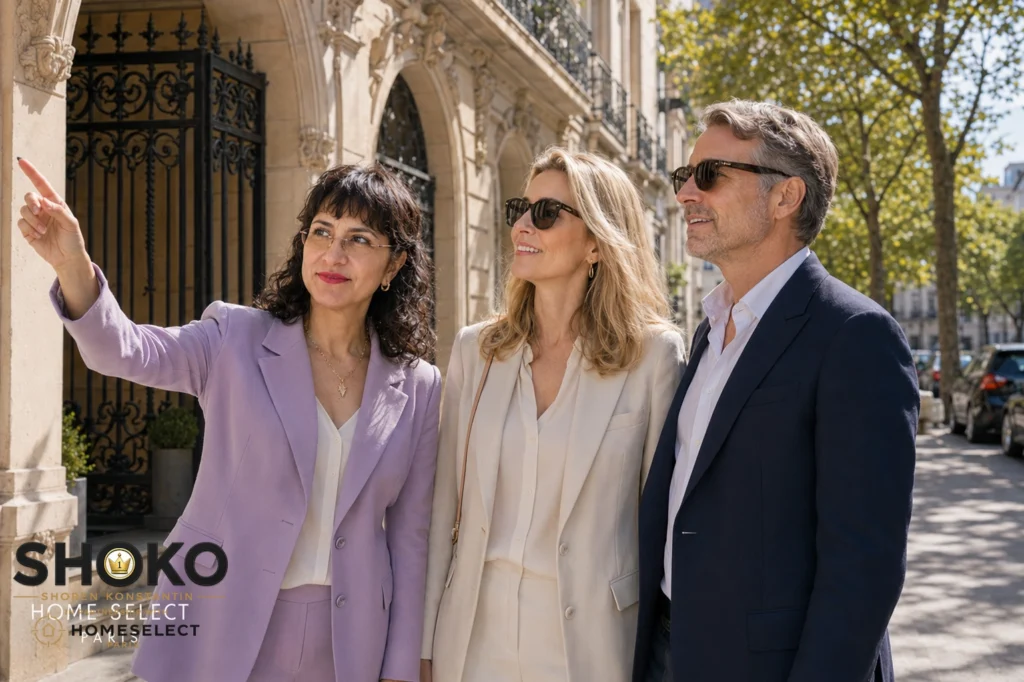
The Most Prestigious Paris Addresses and Why They Command Permanent Premiums
Anyone who has spent serious time in the Paris luxury market eventually notices something that contradicts the usual logic of real estate: within the same arrondissement, on streets separated by only a few hundred metres, prices can diverge by a substantial margin — and the gap does not close, even across market cycles that move every other segment of the city. This is the address premium, and understanding it is essential for any buyer thinking about Paris as a long-term store of value rather than simply a place to live.
Why the Arrondissement Is Not the Real Unit of Prestige
International buyers new to Paris often think in terms of arrondissements — the 7th, the 8th, the 16th — as though each carries a single, uniform price level. In reality, the arrondissement is only the first filter. Within the 7th, a property facing the Champ de Mars commands a meaningfully different premium than one a few streets away with no view at all. Within the 8th, proximity to specific avenues and the historic hôtels particuliers that line them creates pricing tiers that have nothing to do with square footage and everything to do with the address itself.
This is the same principle explored in why Paris trophy apartments remain the world’s most discreet wealth store — value in this segment of the market is anchored to specific streets and specific buildings, not to a broader neighbourhood label. A buyer who only researches at the arrondissement level will consistently misjudge what a genuinely exceptional address actually commands relative to an adequate one nearby.
What Actually Creates a Permanent Premium
A handful of factors combine to create addresses that hold premium pricing indefinitely. Architectural significance matters enormously — a building designed by a recognised Haussmann-era architect, or a genuine hôtel particulier with documented history, carries a story that no new construction can replicate. Scarcity matters just as much: streets where the building stock was essentially fixed a century ago, with no possibility of new supply, see demand absorbed entirely by existing inventory.
Proximity to specific landmarks plays a role too, but it is more nuanced than buyers often assume. A view of the Eiffel Tower carries real premium, but a quiet, discreet street near the Champs-Élysées without direct tourist traffic can command an equally strong premium for entirely different reasons — privacy, calm, and exclusivity rather than spectacle. The most enduring addresses tend to combine architectural pedigree with this kind of quiet exclusivity rather than visibility alone, and the buyers who understand this distinction are the ones who end up with addresses that continue to appreciate even when comparable square footage elsewhere stalls.
Why These Properties Almost Never Reach the Open Market
The most prestigious addresses in Paris are also, almost without exception, the addresses where transactions happen with the least public visibility. Owners of significant properties on these streets are rarely motivated sellers in the conventional sense — they are typically transacting for estate planning, generational transition, or a specific personal circumstance, and they prioritise discretion over maximum public exposure every time.
This means that genuine access to this segment of the market depends almost entirely on relationships built over years, not on monitoring listing portals. The right renovation can transform a Haussmann apartment into a trophy property, but finding the underlying property in the first place — particularly on one of these premium streets — is a search problem that public listings simply cannot solve. Buyers who wait for the right address to appear publicly are, in practice, waiting for an event that may never happen at all.
How the Premium Behaves Across Market Cycles
What distinguishes a genuine address premium from a temporary fashion is its behaviour during downturns. Properties on premium streets in the 7th and 8th have historically retained value through periods when the broader Paris market softened, simply because the pool of buyers competing for that specific address never disappears — it may shrink, but it does not vanish the way demand for a less distinguished property can. This resilience is precisely why ultra-high-net-worth buyers treat the specific address, not the broader arrondissement, as the primary determinant of long-term capital preservation.
The Streets That Define the Category
A short list of addresses illustrates the principle clearly. Avenue Montaigne and Avenue Foch in the 8th and 16th carry a premium tied as much to their place in Paris’s social geography as to their architecture. Place des Vosges, with its arcaded stone facades dating to the early seventeenth century, commands prices that bear almost no relationship to anything else in the Marais simply because no comparable square exists anywhere else in the city. The rue de Varenne and rue de Grenelle in the 7th, lined with ministries and historic hôtels particuliers, occupy a similar category — addresses where the building stock is essentially closed to new supply and where ownership changes hands so rarely that each transaction becomes, in effect, a market event in itself.
What unites these streets is not simply that they are expensive. It is that the gap between them and a perfectly good property two streets away does not narrow during a downturn and does not need justifying during a boom — it is simply a permanent feature of how the city’s most discerning buyers allocate capital.
Multi-Generational Ownership Patterns
Properties on these addresses also tend to follow a distinct ownership pattern: many have remained within the same family for two or three generations, transacting only when an estate is settled or a family’s circumstances change entirely. This pattern reinforces scarcity in a way that is almost self-perpetuating — the rarity of transactions is itself part of what makes the next transaction, when it finally occurs, so significant. For a buyer building a multi-generational holding rather than a short-term position, this is precisely the dynamic worth understanding before searching begins, since the properties that fit this profile rarely behave like the rest of the market in either pricing or availability.
For buyers approaching Paris as a long-term store of wealth, the address premium is not a curiosity — it is the central variable. Two apartments with identical square footage, identical finishes, and even identical views can sit on fundamentally different value trajectories depending entirely on which street they occupy and which building history they carry. This is precisely why buyers focused on capital preservation across generations pay disproportionate attention to the specific address, sometimes accepting a smaller or less renovated property on a premium street over a larger, more polished one nearby.
The discipline required here is patience: waiting for the right address to become available privately is almost always a better long-term strategy than acquiring the first comparable property that appears publicly.
If you are evaluating Paris as a long-term acquisition and want access to the addresses that rarely, if ever, appear on the open market, Contact SHOKO and we will discuss what is genuinely available at this level today.
Recommended Reads
Buyer Representation vs Property Listings in France — 1empress.com
How the Right Renovation Transforms a Paris Haussmann Apartment Into a Trophy Property — 1empress.com
The Most Coveted Paris Addresses for Ultra-High-Net-Worth Buyers — gtamarket.ca
What a Paris Buyer Agent Actually Does on Your Behalf — buyeragentfrance.com