
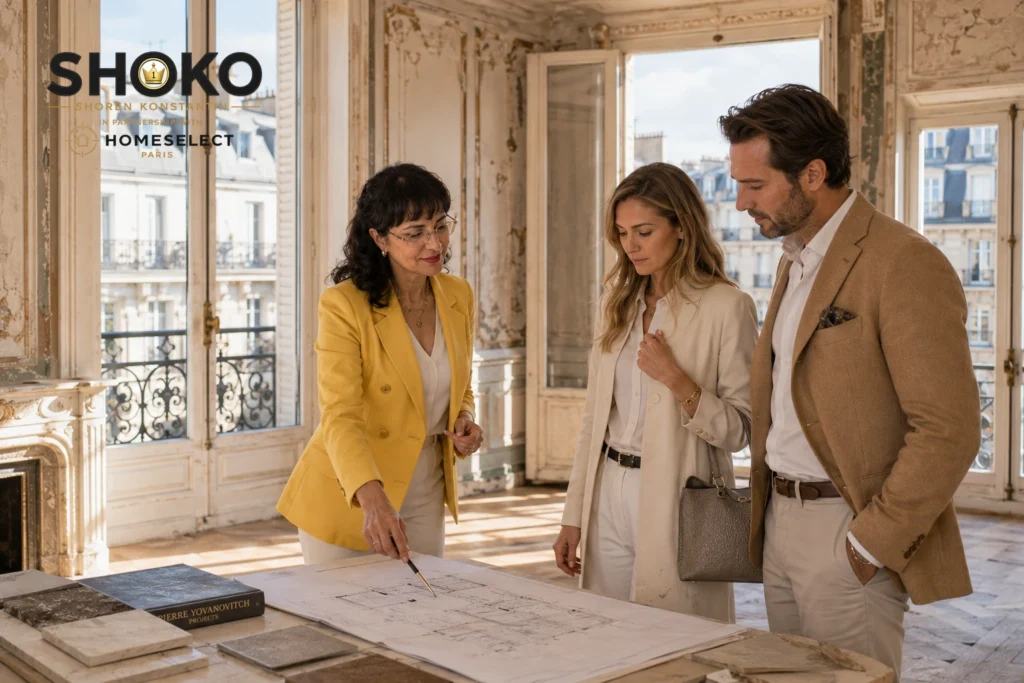
Interior Design and Architecture — How Paris’s Best Apartments Are Transformed
The most coveted Paris apartments are rarely the ones that arrive perfect. Behind nearly every photograph of a flawless Haussmann interior — herringbone parquet running uninterrupted through six rooms, a kitchen that reads as original but functions as entirely modern — sits a renovation that was conceived, argued over, and executed with extraordinary precision. The architecture sets the boundaries. What happens inside those boundaries is where genuine value is created.
Working With the Building, Not Against It
Haussmann-era apartments were built to a logic that predates contemporary expectations of light, flow, and open living. Rooms were designed in sequence — enfilade — with doors aligned to create a vista through several rooms at once, a deliberate architectural statement rather than an accident of layout. The best renovations preserve this logic rather than fighting it, opening selective walls to modernize flow while keeping the proportions and sightlines that made the apartment distinctive in the first place.
This is a different discipline from simply gutting and modernizing. The architects and designers who work convincingly within this category understand which elements are structurally and aesthetically load-bearing in a sense that goes beyond engineering — a marble fireplace, a set of original doors, a ceiling rose — and which are simply dated finishes that can be replaced without loss.
Heritage Detail as a Design Constraint, Not an Obstacle
Many of the apartments in this category sit within buildings carrying some degree of heritage protection, which shapes what is and is not permitted before a single design decision is made. Original moldings, parquet patterns, and painted ceilings, where they survive, are typically treated as fixed elements to design around rather than candidates for removal. This constraint, rather than limiting outcomes, often produces more interesting results than an unrestricted blank canvas would — the tension between historic fabric and contemporary function is part of what gives these interiors their particular character.
The Kitchen and Bathroom Problem Unique to This Category
Nineteenth-century apartments were not designed around modern kitchens, and this is where the most expensive and consequential renovation decisions tend to concentrate. Service areas were historically tucked at the rear of the apartment, connected by a separate staircase, with proportions that rarely suit a contemporary kitchen built for both cooking and entertaining. Successful renovations frequently reposition the kitchen entirely, sometimes reclaiming what was once a maid’s room or a secondary bedroom, while preserving the apartment’s primary reception rooms untouched.
Bathrooms present a parallel challenge, often requiring entirely new plumbing routes through walls that were never designed to accommodate them. This is precisely the category of work where renovation budgets expand well beyond initial estimates if not scoped properly from the outset, and where a buyer evaluating a property pre-renovation benefits enormously from an architect’s assessment before, not after, an offer is made.
What Separates a Trophy Renovation From a Merely Expensive One
Money alone does not produce a trophy result. The apartments that command genuine premium — the ones photographed for international design publications and remembered by every visitor — share a coherence between architectural bones, material choices, and the specific life the space is built to host. A renovation that simply imports a generic luxury vocabulary, regardless of the building’s own character, tends to read as expensive rather than exceptional. Our examination of how the right renovation transforms a Haussmann apartment into a trophy property looks closely at this distinction.
The most successful projects tend to begin with restraint — identifying the three or four elements genuinely worth preserving or restoring at significant expense, and allowing everything else to be resolved more simply around them, rather than treating every square meter as an opportunity for maximalist intervention.
Evaluating an Unrenovated Apartment With This in Mind
For buyers specifically seeking the opportunity to shape an interior from the outset, an unrenovated apartment with strong original bones represents a different kind of acquisition entirely — one where the eventual value is created as much by design judgment as by the purchase price itself. Our guide to buying an unrenovated Paris apartment and creating something exceptional walks through how to assess this potential before committing, including which structural and heritage factors most affect what is ultimately achievable.
A Liquidity Consideration Worth Understanding in Advance
A substantial renovation on a property of this caliber is rarely funded entirely from liquid reserves, and the financing mechanics differ meaningfully from a standard mortgage. Buyers exploring how acquisition and renovation capital can be structured together will find our overview of real estate financing in France as a liquidity strategy a useful starting point before any architectural planning begins, since the available structure can meaningfully shape what is feasible from the outset.
The Discipline Behind the Result
What distinguishes the apartments that genuinely command the market’s attention is not a larger budget so much as a clearer point of view, applied consistently from the first architectural decision to the final detail of hardware and lighting. The owners who achieve this almost always assemble the right team before the first wall comes down — an architect who understands heritage constraints, a designer whose sensibility matches the building’s own character, and someone overseeing the acquisition itself who can identify, before purchase, which apartments genuinely have the bones to support this kind of transformation and which only appear to.
If you are evaluating a Paris property with renovation or design potential in mind, Contact SHOKO for a private discussion about what is realistically achievable.
Materials and the Texture of Permanence
One of the quiet signatures of a properly executed Paris renovation is restraint in material choice. The most convincing interiors favor a small number of genuinely fine materials — natural stone, solid wood, well-considered brass or bronze hardware — used consistently throughout, rather than a wide variety of trend-driven finishes that date quickly. This mirrors the building’s own construction philosophy, where a limited material palette was used with extraordinary craftsmanship rather than variety for its own sake.
Lighting design deserves particular attention in this category, since Haussmann-era apartments were conceived around natural light moving through enfilade rooms during the day and candlelight in the evening — a rhythm that contemporary lighting design must reinterpret rather than override. Poorly considered lighting is one of the most common ways an otherwise well-executed renovation undercuts itself, flattening rooms that were designed to hold shadow and depth.
Timeline Expectations for a Project of This Scale
A genuine architectural renovation of a significant Paris apartment, done properly and with the necessary heritage approvals where applicable, rarely completes in under twelve months, and eighteen to twenty-four months is common for the most ambitious projects. Buyers accustomed to faster renovation timelines in other markets sometimes underestimate how much of this duration is consumed by approvals and the inherent unpredictability of working within centuries-old structures, where unexpected conditions behind a wall or beneath a floor are the rule rather than the exception.
Building this realistic timeline into acquisition planning from the outset — rather than discovering it midway through a project — tends to separate owners who remain satisfied with the process from those who experience it as an ordeal. The apartments that ultimately become true trophy properties are, almost without exception, the product of patience applied as rigorously as design judgment.
Recommended Reads
The Most Prestigious Paris Addresses and Why They Command Permanent Premiums — 1empress.com
Paris Penthouses and Rooftop Properties — The Ultimate Status Acquisition — 1empress.com
Why Paris Luxury Buyers Are Increasingly Targeting Pre-War Haussmann Apartments — gtamarket.ca
Why the Best Paris Properties Never Appear on Public Listings — buyeragentfrance.com