
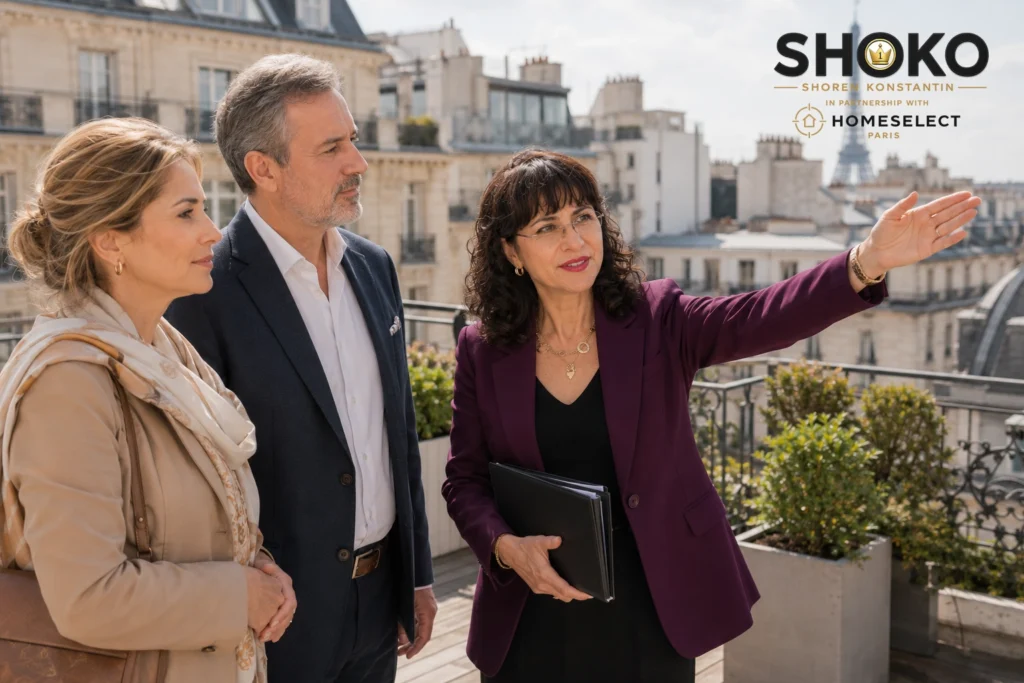
Paris Rooftop Terraces and Exceptional Views — The Most Coveted Features in Ultra-Luxury Property
Every mature luxury market has its scarcest asset — the feature that capital alone cannot manufacture. In London it is the garden square. In New York, the full-floor park frontage. In Paris, it is the private rooftop terrace and the exceptional view: the two attributes that sit at the top of nearly every serious acquisition brief, and the two that the city, by its very construction, produces almost none of.
Understanding why these features command the premiums they do — and how the few properties that possess them actually change hands — is essential context for anyone building a Paris acquisition strategy at this level.
A City Built to Have No Terraces
The scarcity is architectural before it is economic. Haussmann’s Paris was conceived as a city of uniform cornice lines and zinc roofs, its beauty derived precisely from what it forbids: towers, setbacks, and the rooftop structures that produce terraces in other capitals. The result, a century and a half later, is a central city of remarkable visual coherence in which genuinely private, usable rooftop terraces exist only where history made an exception — the top-floor conversion approved decades ago, the 1930s building that broke the pattern, the hôtel particulier with its hidden upper garden.
No meaningful new supply is coming. Heritage protection has tightened rather than relaxed, and the approvals that created the existing stock would largely not be granted today. The terraces that exist are, in effect, the terraces there will ever be — a fixed inventory in a city of two million, facing a global pool of buyers for whom outdoor space in central Paris is the defining requirement.
What the View Is Actually Worth
Views in Paris are valued with unusual precision, because the market has learned to distinguish between their tiers. The protected monument view — the Eiffel Tower, the dome of Les Invalides, Sacré-Cœur — sits at the summit, and its premium is structural rather than sentimental: because the sight lines are legally protected, the view cannot be built out. It is one of the few features in any property market with a legal guarantee of permanence, which is why properties with Eiffel Tower views command permanent premiums through every market cycle.
Below the monument tier sit the rooftop panoramas — the sweep of zinc and slate that defines the Paris skyline — and the classified perspectives over gardens, the river, or a grand axis. Each carries its own market, and each is valued not merely by what is seen but by the floor height, orientation and framing through which it is seen. Two apartments in the same building can differ by a third in value on the strength of one floor and one exposure. At this level of the market, the view is not a feature of the apartment; it is the asset, and the apartment is its container.
The Terrace Calculus
Among the properties that do offer genuine outdoor space, the market applies a quiet hierarchy. A true rooftop terrace — private, directly accessed from the principal rooms, large enough to dine and receive — stands alone at the top. Below it, the deep continuous balcony of the finest Haussmann étage noble, the courtyard-facing terrace of the hôtel particulier, and finally the token outdoor spaces that photograph well and serve little. Discerning buyers, and those who advise them, weigh usable square metres, privacy from overlooking neighbors, orientation, and the technical condition of the terrace itself — waterproofing and structural loading on a century-old building are due-diligence matters, not afterthoughts.
The penthouse floor concentrates all of these questions in their purest form, which is why it constitutes a market of its own — one we have examined in detail in our guide to Paris penthouses and rooftop properties. The essential point for an acquisition strategy is that terrace properties are not a subset of the luxury market; they are a separate, thinner market with its own pricing logic and its own — largely private — channels of sale.
How These Properties Actually Change Hands
Precisely because the inventory is fixed and the demand global, the finest terrace and view properties rarely test the open market. Owners know what they hold. Sales are more often initiated by a discreet inquiry than a listing — a family office signaling interest through an intermediary, an owner quietly sounding out value before an estate transition. By the time such a property would appear publicly, it has typically been offered privately to a short list of qualified buyers.
For the acquiring side, this reverses the usual process: the property is not found, it is surfaced — through sustained presence in the market, relationships with the small circle of professionals who manage these buildings and estates, and the credibility to be shown what is never advertised. Discretion is not a preference in this segment; it is the mechanism of the market itself.
The financial structuring follows the same logic of discretion and efficiency. Many acquirers at this level choose to finance rather than deploy liquidity, for reasons of treasury management rather than necessity — the considerations are set out in our note on real estate financing as a liquidity strategy, and they apply with particular force to assets of this scarcity, where the opportunity cost of a delayed acquisition can exceed any financing consideration.
Valuation Discipline in a Market Without Comparables
The analytical challenge of this segment is that true comparables barely exist. When a terrace property trades once a decade on its street, the usual price-per-square-metre logic loses its footing — and this is where undisciplined buyers overpay and disciplined ones find their moment. The sound approach values the components separately: the interior square metres against the building’s established level, the outdoor space at its own weighted rate, and the view as a distinct premium calibrated against the handful of genuinely comparable transactions across the city, not the quartier. It also prices the irreducible costs — the terrace’s maintenance obligations, the copropriété’s position on rooftop structures, the technical works a century-old roof terrace periodically demands.
Equally important is knowing when scarcity justifies the price and when it merely excuses it. Not every terrace is exceptional, and not every view is protected; part of the discipline is declining the merely rare in order to be ready for the genuinely irreplaceable.
The Enduring Logic
Markets reward many things temporarily. They reward irreplaceability permanently. A private terrace above the rooftops of central Paris, framing a protected view, is as close to an irreplaceable asset as urban property offers anywhere in the world — a fixed supply meeting a demand that renews with every generation of global wealth. That is the quiet logic behind the premiums, and the reason these properties anchor the most sophisticated Paris portfolios.
If a terrace or an exceptional view defines your Paris acquisition brief, Contact SHOKO for a confidential conversation about what is — and what could be — available.
Recommended Reads
The Most Prestigious Paris Addresses and Why They Command Permanent Premiums — 1empress.com
The Discreet World of Off-Market Luxury Paris Property — 1empress.com
The Most Coveted Paris Addresses for Ultra-High-Net-Worth Buyers — gtamarket.ca
A Practical Guide to Paris Property Investment for American Buyers — buyeragentfrance.com