
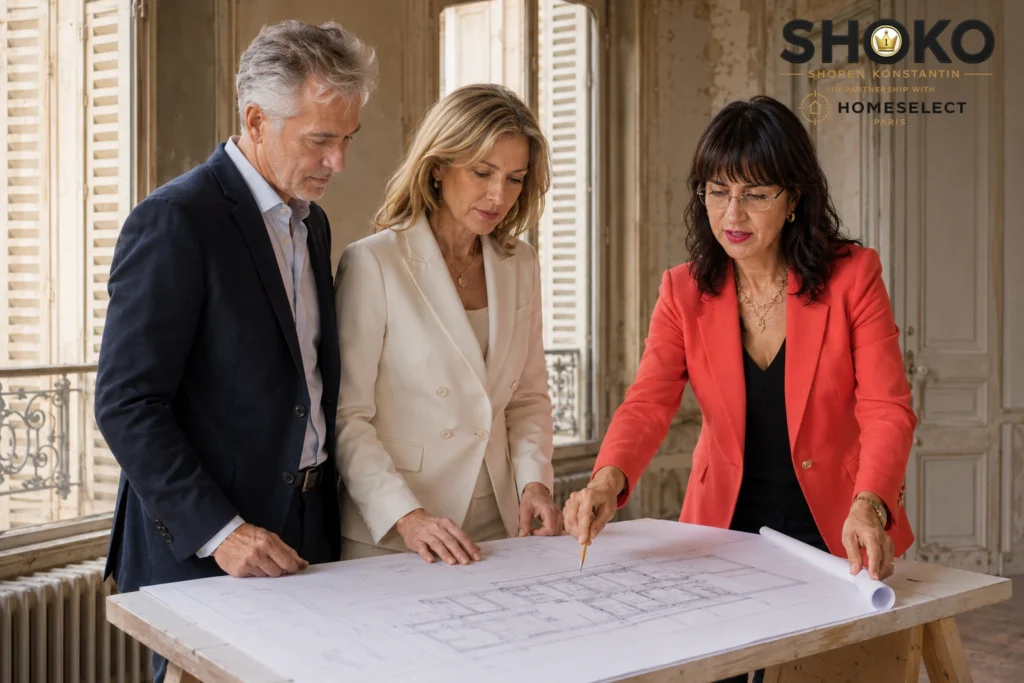
From Unrenovated Shell to Trophy Apartment — A Paris Transformation Guide
The acquisition itself is the shortest chapter of the story. We have written elsewhere about the art of buying an unrenovated Paris apartment — why the finest raw spaces justify pursuit, and how they are found. This guide addresses what almost no one explains to the buyer at the moment of signature: the eighteen to thirty months that follow, step by step, approval by approval, in the actual order the French system will impose them. Because in Paris, a transformation is not a construction project with paperwork attached; it is a sequence of permissions with construction at the end.
The owners who emerge with a trophy — and with their patience intact — are those who understood the sequence before the notaire’s ink dried. The ones who suffer are almost never defeated by cost. They are defeated by order of operations.
Months One to Three — The Approvals That Precede the Architect’s First Drawing
The sequence begins inside the building. Any intervention touching structure, façade, common pipework or the visual exterior — and in a serious transformation, that is nearly everything — requires the copropriété’s blessing, voted at a general assembly that convenes once a year. Miss the annual meeting and the choice is stark: wait most of a year, or fund an extraordinary assembly and persuade owners to attend. Discerning buyers time their acquisition against the building’s assembly calendar for precisely this reason, and their representatives read the last three years of minutes before the offer — both for voted works and for the building’s temperament toward ambitious neighbors.
In parallel comes the question of the state. Much of prime Paris lies within protected sectors or the visual field of classified monuments, where the Architectes des Bâtiments de France hold approval rights over anything visible — windows, roofline, terraces, even shutter colors. Their review adds roughly a month to any filing and a layer of taste to satisfy. It is best treated not as an obstacle but as a co-author: the ABF’s constraints are, in large part, why the streetscape you are investing in cannot be cheapened around you.
Months Three to Six — Permits, and the Team Worth Waiting For
City permissions follow building permissions. Interior reconfiguration without structural or exterior change requires nothing from the city; altering façades, combining floors, or creating openings requires a déclaration préalable, with a review of roughly one to two months; changing structure at scale, or surface beyond thresholds, escalates to a full permis de construire — several months, architect mandatory. In protected sectors, every one of these timelines stretches. A pattern worth internalizing: the permit is rarely the slow step people expect, and the assembly is rarely the fast one.
The same window decides the project’s ceiling: the team. Paris’s artisan aristocracy — the parquet specialists, the staff-plaster ateliers, the marble restorers — book many months ahead, and the difference between a beautiful renovation and a significant one lives almost entirely in these hands, as we examined in how the right renovation transforms a Haussmann apartment into a trophy property. Commission the architect during the approval months, tender to two or three general contractors, and treat a crowded artisan’s calendar as the credential it is. The devis — the binding French quote — rewards patience here: a properly detailed tender set now prevents the renegotiations that consume budgets later.
The Middle Year — Works, and the Discipline of the Budget
Construction itself follows a rhythm the first-time owner should expect rather than fight: demolition reveals the building’s true condition within weeks (in a nineteenth-century structure, assume revelations); structural work and networks consume the quiet middle months; finishes — the visible ten percent — absorb a disproportionate final stretch, because trophy-grade finishing cannot be hurried and should not be.
For the international owner, the middle year raises the question of presence — and the French system has a mature answer. A full maîtrise d’œuvre mandate makes the architect the owner’s representative on site: chairing the weekly site meetings, certifying each payment request against actual progress, and issuing the written site reports that let an owner in Geneva, Dubai or New York govern the project from a distance without governing it blindly. The fee for this level of stewardship typically runs 10–15% of the works — and on a trophy-grade project, no line in the budget buys more protection per euro.
The financial architecture matters as much as the physical one. Seasoned owners stage payments strictly against milestones, retain the customary holdback until reception, and budget a contingency of twenty percent — not as pessimism but as arithmetic, since a Haussmann shell has had a century and a half to prepare its surprises. Two quiet advantages soften the totals: renovation works in older buildings attract reduced VAT rates rather than the full rate, and for acquisitions structured with financing, works can often be folded into the original loan — one of several reasons the approach outlined in our note on financing as a liquidity strategy deserves consideration before, not after, the purchase of a shell.
Reception — The Hour That Protects the Investment
Owners who plan to furnish to the same standard should commission the interior architect during the works, not after them — the joinery, lighting and stone decisions belong to construction, and retrofitting them costs double.
The project ends with a legal moment, not a housewarming: the réception des travaux, the formal walk-through at which the owner accepts the works and records every reserve, however small. From that signature flow the guarantees that protect the investment for a decade — the one-year completion warranty, the two-year warranty on equipment, and the ten-year décennale covering structure, backed by the contractor’s mandatory insurance. Owners who treat reception as a formality surrender leverage they can never recover; owners who arrive with their architect and a methodical list convert the day into the final act of quality control. File every attestation with the title deed: for a trophy apartment, the renovation dossier becomes part of the provenance, and the next generation of buyers will ask for it.
The Timeline, Honestly Stated
Assembled end to end — assembly approval, ABF and permits, tendering, the works themselves, reception — a genuine shell-to-trophy transformation in prime Paris runs eighteen months in disciplined hands and closer to thirty when the building, the city or the shell itself has opinions. That duration is not the system failing; it is the system doing precisely what preserves the value being created. Speed is available in Paris — but not in the buildings worth transforming.
For the buyer prepared to hold that timeline, the reward remains what it has always been: an apartment that exists nowhere else, in a city that will never permit another to be built. To discuss, in confidence, how such a project is sequenced from acquisition onward, Contact SHOKO.
Recommended Reads
Interior Design and Architecture — How Paris’s Best Apartments Are Transformed — 1empress.com
Paris Apartments With Private Terraces — The Rarest Combination in the Luxury Market — 1empress.com
Historic Parisian Hôtels Particuliers — What Serious Buyers Need to Know — gtamarket.ca
Why the Best Paris Properties Never Appear on Public Listings — buyeragentfrance.com