
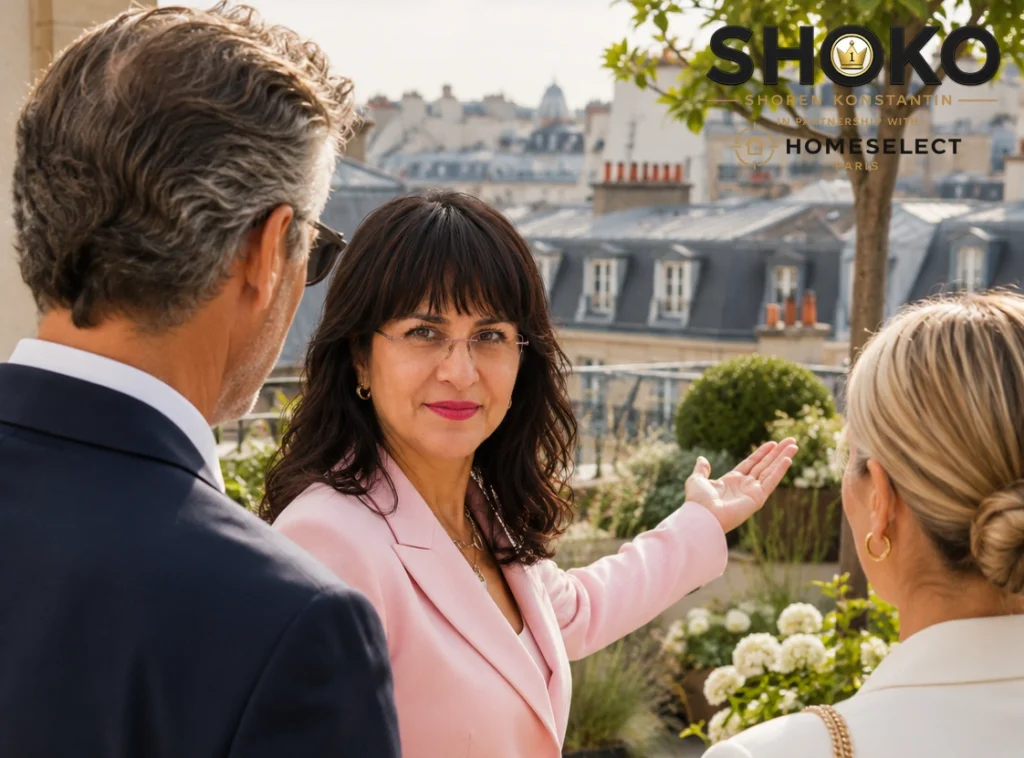
Paris Apartments With Private Terraces — The Rarest Combination in the Luxury Market
Every mature luxury market has its scarcest attribute — the single feature that cannot be created, only found. In London it is the garden square key; in New York, the full-floor landmark penthouse. In Paris, it is far simpler and far rarer: a genuine private terrace attached to an apartment of consequence. Estimates circulating among the city’s specialist agencies suggest that meaningfully sized private terraces exist on well under five percent of Parisian apartments — and within the prime arrondissements, where Haussmann’s uniform rooflines were never designed to accommodate them, the true figure is smaller still.
This scarcity is not a market condition. It is architecture. And architecture, unlike fashion, does not correct. Interest rates move, currencies move, taste itself moves — the number of significant terraces above the prime arrondissements remains, decade after decade, essentially what it was.
Why Paris Was Built Without Them
The Haussmannian building — the very stock that defines prime Paris — was conceived between 1853 and 1914 as a sealed composition: continuous stone façades, mansard roofs of zinc and slate, service floors beneath. Outdoor space belonged to the street, the courtyard and the public garden, not to the private apartment. The balconies that ribbon the second and fifth floors are ornamental filigree, generous enough for a pair of chairs and rarely more.
A true terrace, therefore, almost always represents an exception in the fabric: the setback crowning a 1930s building, the roof of a lower neighboring structure legally annexed decades ago, a top-floor reconstruction approved in an era of more permissive planning, or the private garden level of a courtyard hôtel particulier. Each terrace of consequence has a story of architectural accident behind it — which is precisely why no two are comparable, and why pricing them defeats ordinary methods.
What the Combination Actually Costs
The market prices outdoor space in Paris with unusual clarity: specialist valuations commonly attribute between thirty and fifty percent of the interior square-meter rate to well-oriented terrace surface, with the multiple rising further when the terrace is large, level with the principal rooms, and blessed with a protected view. On a prime apartment already trading near €15,000 per square meter in the 6th or 7th arrondissement, a hundred-meter terrace is not an amenity; it is a second asset fused to the first.
Yet the arithmetic understates the reality. Apartments combining significant interiors with significant terraces in the prime arrondissements trade so infrequently that comparables age into irrelevance between sales. In these conditions the terrace behaves less like priced space and more like provenance — the buyer is not paying for square meters of tile but for membership in a category that may not offer another opening for years. The same logic governs the adjacent rarities of the market, from the garden apartments that constitute their own scarce asset class to the protected sightlines of the monuments.
Reading a Terrace Before Acquiring One
Discernment matters more here than in any other segment. The first question is legal rather than aesthetic: is the terrace privative — exclusively yours under the copropriété’s founding documents — or merely a common area with tolerated private use, a distinction that has unwound more than one transaction late in due diligence. The second concerns what may be done upon it: planting, shading, glazing a winter garden — each may require the building’s assembly, the city, or in protected sectors the state’s own architects to agree.
A further distinction separates the connoisseur from the enthusiast: the difference between a terrace and a large balcony dressed as one. Parisian marketing is generous with the word; the market is not. A terrace of consequence is level with its principal rooms, accessible from more than a single French door, and capable of holding a dinner for eight without choreography. Anything narrower is charming — and priced accordingly by the buyers who eventually resell it.
Then come the quieter technical judgments. A terrace is a roof, and roofs carry waterproofing membranes with finite lives whose renewal, for the apartment below, is a matter of ceilings. Orientation decides whether the space serves June evenings or merely photographs; the west and south exposures command their premium for a reason. And the view across the zinc rooftops — the feature that elevates the penthouse and rooftop properties at the summit of the market — should be verified against the neighboring parcels’ building rights, because in Paris a view is only permanent when the planning code says it is.
Where They Exist — and How They Trade
The terraces of consequence cluster where the architectural exceptions cluster: the 1930s buildings of the 16th arrondissement’s western avenues and Neuilly’s border, the reconstructed top floors of the 8th around the Triangle d’Or, the courtyard gardens and rooftop annexes of the 6th and 7th, and the artists’-studio conversions of the western 17th. The Marais contributes the occasional hôtel particulier roof garden — jealously guarded and almost never marketed.
Timing carries its own intelligence in this segment. Terrace apartments photograph — and show — at their most persuasive between May and September, and sellers know it; the discreet mandates tend to open in spring. The counterintuitive consequence is that the serious buyer’s advantage lies in the colder months, when a terrace must be judged on its bones rather than its geraniums, and when the rare owner selling in November is usually an owner with a reason to conclude.
That last phrase describes the segment’s defining behavior. Owners of these apartments understand precisely what they hold; when they sell, they sell quietly, through the two or three intermediaries they trust, to buyers who were vetted before they were informed of the opportunity at all. In several years of observing this market, the pattern holds: the terrace apartments that reach public portals are, with rare exceptions, the ones the private circuit has already declined. For a buyer whose acquisition may involve structuring the purchase around a financing profile rather than a simple transfer of funds, the considerations set out in our note on real estate financing as a liquidity strategy apply here with particular force, given the sums these properties command.
The Category That Does Not Wait
Most luxury attributes in Paris reward patience; the market produces another exceptional renovation, another beautiful étage noble, every season. The private terrace obeys a different clock. The city will not permit the rooflines to change, the copropriétés will not surrender their common space, and the owners — who understand all of this perfectly — are in no hurry whatsoever. What exists is what will exist.
For the buyer who has decided that outdoor space in central Paris belongs in the portfolio, the practical conclusion is straightforward: the search must be positioned inside the private circuit before the next opening occurs, not after. Contact SHOKO to discuss, in confidence, how that positioning is arranged.
Recommended Reads
Why Paris Properties With Eiffel Tower Views Command Permanent Premiums — 1empress.com
The Most Prestigious Paris Addresses and Why They Command Permanent Premiums — 1empress.com
The Most Coveted Paris Addresses for Ultra-High-Net-Worth Buyers — gtamarket.ca
Why the Best Paris Properties Never Appear on Public Listings — buyeragentfrance.com