
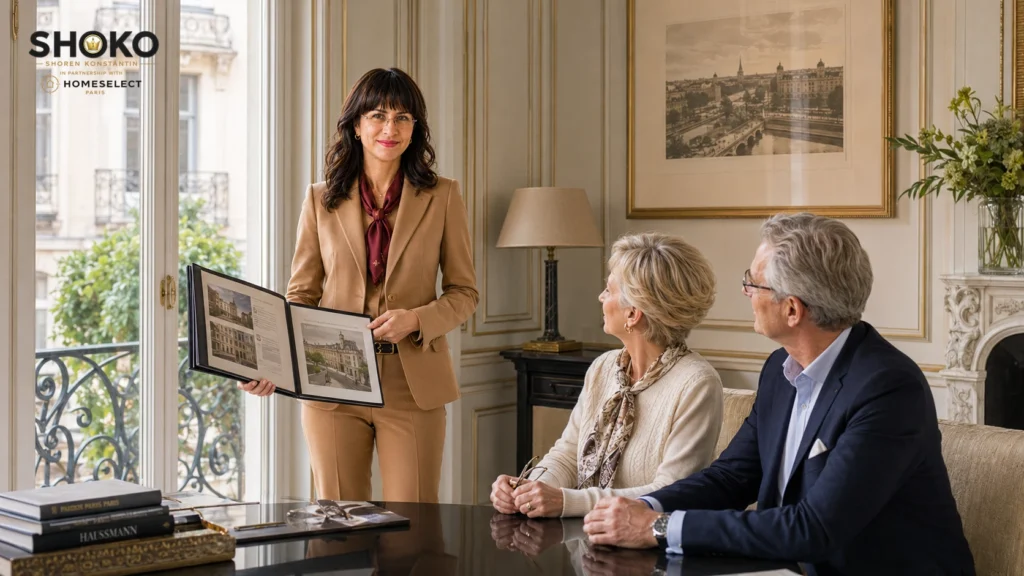
The Paris Trophy Apartment as a Store of Generational Wealth
Every significant fortune eventually confronts the same question: what survives? Portfolios are rebalanced, companies are sold, currencies drift — but a family needs somewhere for its wealth to live, in both senses of the word. For more than a century, a particular class of asset has answered that question with unusual consistency: the Paris trophy apartment. Not merely as an investment, but as the physical form a family’s legacy takes — the address where inheritance stops being a number and becomes a place the next generation walks into.
What Makes an Asset Generational
A generational asset must satisfy conditions that very few investments meet simultaneously. It must be scarce in a way that cannot be manufactured: no one will build another étage noble overlooking the Champ de Mars. It must be legally durable: Paris title rests on a civil code in continuous operation since 1804, with property rights that have survived every regime, war and crisis since. It must be useful while it is held: a trophy apartment shelters the family, hosts its gatherings, anchors its presence in Europe. And it must be legible to the next generation — heirs understand a residence on the Left Bank in a way they may never understand a derivatives book.
The finest Paris apartments meet every condition. We have examined why trophy apartments remain the world’s most discreet wealth store; the generational dimension is the natural extension of that same logic across time rather than merely across borders.
The Arithmetic of Permanence
Official French government transaction data places the most coveted arrondissements — the 6th and 7th above all — at roughly €14,500 to €15,000 per square metre on average, with true trophy properties trading well beyond it. What matters for a family is not the level but the behaviour: these are low-volume, high-scarcity markets where supply is fixed by history and demand is refreshed by every generation of global wealth. Prices in the protected core do not follow the wider cycle so much as breathe with it — softening modestly, recovering first, compounding quietly across decades.
That behaviour is precisely what a store of generational wealth requires. The family that bought well in the 7th in the 1980s did not merely keep pace with inflation; it holds an asset that three generations have used, that never needed to be sold in a downturn, and that grew more irreplaceable every year.
From Inheritance to Legacy
Here lies the distinction the great families understand instinctively: inheriting money is not the same as inheriting a legacy. Liquidity passes to heirs as a balance — abstract, divisible, easily dissipated. A trophy apartment passes as an obligation and an identity: an address the family keeps, maintains and returns to. The transformation of inherited capital into a Paris residence is, in effect, the conversion of money into meaning — the moment a fortune acquires a permanent home.
The most sought-after form of that permanence remains the great address. As we explored in our study of the most prestigious building addresses in Paris, the building itself carries the standing: the right immeuble on the right street is recognisable to every generation of buyers, which is exactly why such apartments so rarely need to find one.
The Questions of Succession — Handled Properly
France orders inheritance differently from common-law jurisdictions. Forced heirship reserves a defined share of an estate for children; the notaire holds a legal monopoly over property succession; and ownership structures — direct title, an SCI, dismemberment into usufruit and nue-propriété — carry materially different consequences for how an apartment passes and what it costs to pass it. These mechanisms are well established and entirely navigable, but they are not matters for improvisation or for advice absorbed secondhand. Every serious question of structuring and succession ends in the same place: consult a notaire, early, before the acquisition rather than after it.
What a family can decide for itself is the intent — whether this apartment is to be a residence, a legacy vehicle, or both — because that intent should shape everything from the arrondissement to the ownership structure.
Stewardship — The Discipline Between Generations
A legacy asset is not merely acquired; it is kept. The great Paris apartments that pass gracefully between generations share an owner’s discipline that is easy to describe and rare to practise. The building is attended to: an engaged presence in the copropriété, works voted and funded before they become urgent, a relationship with the syndic and the gardien that protects the family’s interests when it is an ocean away. The apartment itself is renewed on a generational clock — a serious renovation every few decades that honours the volumes and the period detail while quietly rebuilding everything behind the walls, so that each generation inherits an apartment of its own century rather than a museum of the last one.
Done well, this stewardship is itself accretive. In the protected core of Paris, an impeccably maintained étage noble with restored mouldings and contemporary systems does not merely hold its position in the market — it advances it, because the pool of such apartments shrinks every year while the pool of families seeking them does not. The cost of stewardship, measured across thirty years, is trivial against what it protects; the cost of neglect, in a copropriété allowed to drift or a renovation deferred past its time, is the one force that can genuinely erode a trophy asset.
Acquiring for the Next Half-Century
An acquisition made for generations is made differently. The brief privileges permanence over fashion: the protected core arrondissements, the noble floor, the bones of the apartment — volume, light, orientation — over its current decoration. It privileges discretion: the finest legacy properties change hands off-market, between families, through representatives. And it treats liquidity with respect rather than urgency — many such acquisitions deliberately preserve the family’s capital position, and the mechanics of real estate financing as a liquidity strategy exist precisely for buyers who could pay outright but choose not to.
Above all, it is unhurried. The right apartment for fifty years is worth a search measured in months. The families who hold the great addresses of Paris did not find them on a portal; they were introduced, they waited, and they moved decisively when the singular property appeared.
For a private conversation about acquiring a Paris residence intended to outlast its buyer, Contact SHOKO.
Recommended Reads
Paris Trophy Real Estate — The Ultimate Buyer’s Guide — 1empress.com
Why Ultra-High-Net-Worth Buyers Use a Representative, Not a Search, to Acquire Property in Paris — 1empress.com
How Paris Luxury Apartments Hold Value Through Economic Cycles — gtamarket.ca
Why the Best Paris Properties Never Appear on Public Listings — buyeragentfrance.com