
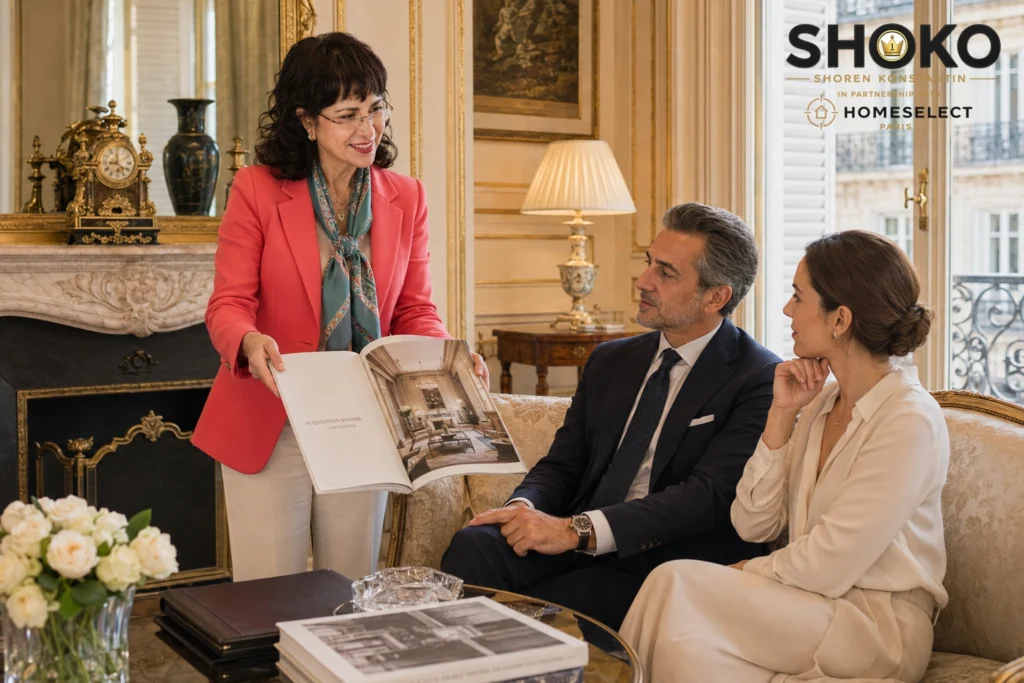
Paris Trophy Real Estate — The Ultimate Buyer’s Guide
There is a subset of Paris real estate that does not advertise. It does not appear on the major property portals. It requires no photography campaigns, no floor plan illustrations, no open days. The properties that belong to this category are known among a small network of advisors, notaires, family offices, and institutional holders, and the buyers who ultimately acquire them have generally spent considerable time — and engaged precisely the right representation — to arrive at the moment when such a property becomes genuinely available to them.
Trophy real estate in Paris is a category defined by convergence: the right property, in the right building, on the right street, with the right proportions and the right architectural integrity. It is not a synonym for expensive. It is a description of scarcity at the highest level of a market that is itself already highly selective. Understanding that distinction — and understanding what it demands of any serious buyer — is the necessary starting point for any acquisition at this level.
What Constitutes Trophy Real Estate in Paris
The definition is architectural before it is financial. A trophy Paris property has ceiling heights that the building’s original architect designed for formal reception — typically 3.5 metres or more, often considerably higher on the piano nobile floors of buildings dating from the Second Empire or earlier. The floor plan reflects a logic of residential living that modern construction almost never replicates: an enfilade of principal rooms with connecting double doors, a private bedroom quarter, a service wing still structurally intact, and rooms that face the street or a private garden rather than an undistinguished inner courtyard.
The building carries weight independent of the apartment it contains. A building with a classified historical facade, a grand entrance hall that has been maintained with care, and a co-propriété with a coherent history of investment is categorically different from a building of similar apparent style that has been less carefully managed across generations. The former creates an environment. The latter creates a backdrop. Buyers at this level understand the distinction from the first visit.
The address constitutes the third dimension of trophy definition in Paris. Certain streets — Rue de Varenne, Rue de Grenelle, Avenue Foch, Rue de Fürstemberg, the immediate environs of the Place des Vosges — carry a permanence of prestige that no market cycle has ever meaningfully eroded. Properties on these streets, in the correct buildings, have been coveted by serious buyers across every generation in living memory.
The Categories of the Exceptional
Within the trophy designation, several distinct categories present themselves to buyers approaching this level of the Paris market.
The grand appartement on the piano nobile is the most consistently sought. In a classical Haussmann building, the first or second floor above the entresol was constructed to the most generous specifications in the building — the largest windows, the highest ceilings, the most elaborate plasterwork and carved door surrounds, the most light from the most favourable angles. These apartments, when they present with original features substantially intact, represent the canonical expression of Parisian residential prestige. They are what serious buyers mean when they describe what they are looking for, even when they have not yet articulated it in those terms.
The penthouse with a protected roofscape view commands its own intense and persistent demand. Properties with private terraces overlooking a classified Parisian skyline — the great domes, the Seine, the Eiffel Tower from the correct angle, the roofscape of the Île Saint-Louis — belong to a taxonomy of rarity that cannot be manufactured or replicated by any developer. Once such a view exists and is properly protected, it is permanent, and the market understands this precisely.
The hôtel particulier — a private historic mansion, most often found on the Left Bank — represents the apex of the trophy category in Paris. These are properties that have existed as significant private residences for generations, often with private courtyard gardens, multiple principal floors, and histories that in some cases predate the Haussmann transformation of the city entirely. A small number change hands each year, and the acquisition of one requires preparation, genuine patience, and an advisor with established access to this particular circuit.
The Off-Market Reality
A meaningful proportion of trophy acquisitions in Paris are completed without the property having appeared on any public listing platform. This is not an anecdote or an approximation — it is the structural reality of a market where sellers at this level have no interest in broad exposure, and where the appropriate buyers can be reached through networks that operate entirely independently of portals or marketing campaigns.
Off-market access is not a function of budget. It is a function of the relationships that an advisor has cultivated over time with the people who control, or have advance knowledge of, what is approaching availability — the selling notaire, the estate lawyer managing an inheritance, the co-propriété manager of a building where a family has held an apartment for decades, the advisor of a holder who is considering disposition but has made no formal announcement. These relationships take years to build and cannot be acquired by commission alone. They are the product of a sustained professional presence in a specific environment.
For a buyer approaching the trophy segment, this means that the most consequential decision in the entire acquisition process is not which property to make an offer on. It is which advisor to engage before the search has begun.
The Acquisition Process at Trophy Level
A trophy acquisition in Paris begins with a structured and precise brief — an articulation of what the buyer is looking for, what they are genuinely prepared to pay, and what their timeline and discretion requirements are. This brief is not shared publicly. It is used to activate a private network of contacts who may have relevant knowledge in the relevant buildings and streets.
The shortlist that emerges from this process is not curated by volume. It is curated by quality. Three properties that genuinely meet the criteria are of incomparably more value to a serious buyer than thirty that approximate them. Each property on the shortlist is visited with purpose, assessed by the advisor and ideally by an independent structural specialist, and evaluated not only on its present condition and immediate attractions but on its longer-term potential and its structural limitations.
The offer, when it is structured, is prepared carefully. At this level of the market, the terms — the deposit structure, the conditions precedent, the timeline to completion — can matter as much as the headline price. A well-advised buyer presenting a clean, credible, unconditional offer frequently outperforms a higher bidder who presents complexity or uncertainty. Sellers at the trophy level are not always motivated primarily by price. They are motivated by certainty, discretion and the confidence that a transaction will complete on the terms agreed.
Notaire fees, following the April 2025 increase in the departmental land registration tax, now run to over 8% of the acquisition price, in addition to any advisory or agency fees. This is a significant line item that must be fully integrated into the acquisition budget from the outset of any serious planning.
Discretion as the Operating Principle
Trophy acquisitions in Paris are conducted in confidence. The identity of the buyer, the price achieved, and the terms of the transaction are not subjects for public discussion, and the most accomplished advisors in this segment treat confidentiality not as a courtesy but as a professional obligation with no exceptions.
The French notaire process provides a degree of structural discretion that benefits buyers at this level. Transactions are registered in the name of the legal purchaser, which may be a holding structure rather than a named individual, and the public record is minimalist by design. Sellers at the trophy level frequently make confidentiality a condition of any offer consideration — not as a negotiating posture but as a genuine requirement.
Buyers who wish to operate with the same discipline need an advisor whose professional ethos is built on the same foundation. The first conversation should make that clear on both sides.
Trophy real estate acquisition in Paris is a process, not a transaction. Contact SHOKO to discuss your acquisition brief and the properties that may be available through private channels.
Recommended Reads
Why Paris Trophy Apartments Remain the World’s Most Discreet Wealth Store — 1empress.com
Buyer Representation vs Property Listings in France — 1empress.com
How Paris Luxury Apartments Hold Value Through Economic Cycles — gtamarket.ca
How a Buyer Agent Gets Foreign Buyers Better Paris Properties — buyeragentfrance.com